1.10.2010

Avatar. Wow.

At their best, movies are an escape, an opportunity to experience times and places disparate from one's own life. These adventures can take the audience to a nearby country, or maybe a different era, or even just plant them among a different class of people. Plenty of classics like The Godfather and Casablanca excel by atmospherically yanking the viewer into a world not wholly unfamiliar at the time, then adding a resonant story involving grand and powerful themes.

Good fantasy movies have an inherent ability to enrapture like nothing else, because they create entirely new worlds often set in entirely different times, novelties that are best understood and experienced by fulling giving oneself to the story. Plenty of fantasy movies have failed miserably, and all the money in the world doesn't guarantee that the effects and images will enthrall audiences (The Phantom Menace). When done well however, fantasy is not only for geeks, but for any open-minded person willing to spend a couple hours in a new place. In Avatar, that new place is Pandora, a distant Earth-like moon where humans involved with both science and the military are attempting to learn more about its unique inhabitants and possibilities.

Director/producer James Cameron escalates the built-in fantasy advantage by adding the element of 3-D, which has been used in many movies, but rarely with much success. My goodness, does Cameron ever know how to use 3-D. From the opening shot, one realizes that this is no ordinary film. As the movie continues, the camera maneuvers deftly around rooms, rustles through the brush, floats amidst the trees, and soars between mountains. When used well, good camera movement adds a strong dynamic to traditional shots. Cameron goes beyond that, presenting breath-taking new angles with enhanced perspectives that reach out and envelope the viewer in stunning fashion. There's probably something about wearing 3-D glasses that subconsciously adds to the experience as well. I have never felt as physically connected with a movie.

Words can scarcely describe how enrapturing the visuals are. Their power cannot be overstated. I spent half the movie gasping, wide-eyed and open-mouthed at the countless Did-You-See-That! moments. For most of the drive home, I was shaking my head, in awe of the entirely new world on the planet Pandora. It was like watching the documentary series Planet Earth, but in three dimensions and (believe it or not) with better imagery. Movies often trumpet that they are unlike anything you've ever seen, but Avatar can justifiably say precisely that.

I can count my transcendent cinematic experiences on one hand. By transcendent experience, I mean more than just a great movie. I mean an engrossing movie that thrills the senses. Something so atmospheric that it seems to engage more than merely eyes and ears. Avatar joins the list, as its three dimensions create an almost tactile experience amidst the beautiful flora and fauna of Pandora. Perhaps the greatest compliment is this: the political and environmental subtext is fairly obvious and potentially irksome, but I was so immersed in the spectacular world that I didn't care. That's how I knew Avatar had me.

Overshadowed by the remarkable look and feel of the film is the less groundbreaking story. In one sense, calling it a weakness is an overstatement, because the narrative does its job. It provides a framework to supports the stunning visuals, by tweaking familiar arcs enough to keep them fresh. On the other hand, the story is laced with great themes of love and sacrifice, but lacks the powerful ancillary ideas that might have pushed the film to a more exclusive stratosphere. If the unprecedented visuals were buttressed by a better story, Avatar might have been on an extremely short list of all-time greats. Or perhaps such a potent narrative mind have distracted from the eye-popping pictures. Either way, a week after seeing the film, the unforgettable world lingers and resonates far more than the story.

Bottom Line: I've seen better movies in my life, but I've never had a better cinematic experience than Avatar in IMAX 3-D. 9.5 out of 10.

8.03.2009

(500) Days of Summer.

(500) Days of Summer is not a typical indie romantic comedy. As the poster accurately states, this is not a love story, it's a story about love, which makes for a unique movie experience, through both content and manner of storytelling.

The movie traces 500 days of the relationship between Tom (Joseph Gordon-Levitt) and Summer (Zooey Deschanel), but does so in an nontraditional way, bouncing from point-to-point in their romance by use of a scene-opening counter, which displays the day and stage of the relationship. The non-linear method of storytelling is a tool that provides the movie with a layer of poignancy absent from most romantic comedies.

The movie effectively captures the various moments of life and love: the highs, the lows, and the in-betweens. By leaping back-and-forth through time, these snapshots are uniquely juxtaposed in a way that keeps your emotions on a yo-yo, yanking you back to a happy moment when things look bleak, and reminding you of what is and could be ahead when all seems perfect. This shunning of the usual smooth story arc is disorienting initially, as you try to mentally collect and sort the pieces you have seen. But you soon relax, realizing that the flow of events is self-explanatory enough that the precise order is not necessary.

Given the unusual nature of events, which provide the movie with a slight fairy tale feel, a few other filmmaking twists are also used effectively. The movie occasionally breaks from reality, sticking in a song-and-dance number to joyously show the excitement of new love, and a brilliant use of split-screen that simultaneously shows expectations and reality much better than any after-the-fact dialogue could have done. In a straightforward movie, these techniques would have been jarringly out of place, but since the primary method of storytelling is already off the wall, these even zanier choices feel no more unusual, adding to the freshness of the tale.

The movie is much more than cinematic gimmickry, due to the likability of the two lead actors. Gordon-Levitt continues to grow wonderfully as an actor, bringing to the role a youthful maturity often missing in similar films. Deschanel is excellent as always, with her wide-eyed quirkiness that perfectly fits Summer's perspective on love. The two have the precise amount of chemistry for the relationship, nailing the distance or lack thereof at every point along the way, and their infectious exuberance keeps the viewer interested throughout.

(500) Days of Summer is in no ways a typical movie, either in story or method. In this way, it accurately and beautifully mirrors the roller coasters of life and love. Life is not perfect. A love story doesn't always unfold in three acts. Everybody doesn't necessarily live happily ever after. That does not mean imperfect experiences are not worthwhile. The ability to reflect and learn from the past is part of what makes us human, and this film is a first-class exhibit of that aspect of humanity.

Bottom Line: A refreshingly creative change-of-pace that accurately reflects the tumultuous vagaries of life and love. 8/10.

7.18.2009

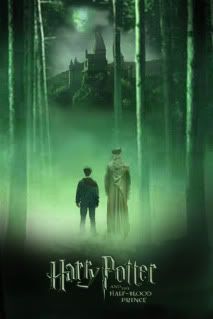
Harry Potter and the Half-Blood Prince.

When I see and review movies that are adapted from books I've read, I try not to get wrapped up in the similarities and differences, because I think doing so can ruin the cinematic experience by distracting from the movie, which often must tweak the story to translate it to the big screen. Having said that, this review is a bit of an exception, because many of the weaknesses of the movie are precisely the strengths of the book. That may not be entirely fair to the movie, but so be it...

Harry Potter and the Half-Blood Prince (HPHBP) is the story of Year Six at Hogwarts, where our trio of heroes returns to school as a strengthening Lord Voldemort and his army of Death Eaters begin to wreak havoc on both the wizarding and Muggle worlds.

Getting right to the point, the movie's primary problem is that nothing drives the story. The book is propelled by three main questions: What is Draco up to? Who is this Half-Blood Prince whose book Harry possesses? Why is Dumbledore showing Harry the various memories? These three interwoven storylines, combined with a side of romance, effortlessly carry the book through its 700+ pages, sprinting to the finish in an absurdly entertaining final five chapters. But the movie mishandles these three major questions and fails to carry much of this palpable drama to the screen.

In the movie, the answer to the first question is made apparent to the viewer early in the movie. The main characters don't learn the answer, but the audience does, an odd cinematic choice that deprives the narrative of its usual protagonist-based power. The second question is a continuing arc that is given short shrift throughout, to the extent that when the riddle is answered in the final moments, it's merely an "Oh."-inducing throwaway line rather than a "Wow!"-inducing culmination of 2+ hours of mystery. The final question does move the movie along somewhat, but the numerous omitted memories rob Voldemort of his explanatory traits, as well as Dumbledore of his motives. Voldemort thus feels like a typical two-dimensional villain rather than the vortex of evil he ought to be, and Dumbledore seems to be more of an uncertain guide instead of a presciently powerful wizard. As for the romance angle, those scenes are executed well enough, including a few poignant teen moments, but neither one of the potential pairings seems fully fleshed out. They don't necessarily feel wrong, but they do feel inadequately supported.

On the bright side, the highlight of the HPHBP is undoubtedly its not-so-bright look. With its washed-out appearance that borders on black-and-white at times, this colder version of Hogwarts is an appropriately stark contrast to the warm and cheery home portrayed in the first two films. But aside from the look, which accurately expresses what the tone ought to be, given the lurking evil, the tone itself doesn't match.

The best part of Order of the Phoenix was the way that director David Yates captured the spirit of the book, effectively displaying the magical and dangerous wizarding world yet also taking time to show smaller moments of laughter and friendship, which were to be treasured as the dark times approached. Yates is not nearly as effective in HPHBP. The vivacity is largely absent, and while some of that is understandable due to the nature of the events, it's still a world of magic. Too often the movie seems to forget that. I will say that the cave scene in the final act is quite magical and quite good, though still a bit rushed. Finally at that point the movie seems to have a purpose, even if it isn't entirely clear what that purpose is.

Without the aforementioned compelling story arcs or the brisk pace of OOTP, the film meanders throughout, running in place for two and a half hours and failing to build momentum as the narrative leaps between arcs, as though not sure where to go while killing time until the climactic final movies. Despite this, the 150 minutes rarely seem to drag, which speaks to the potency of the source material and the attachment that book readers have to the characters.

In the end, the movie's focus is shallow and wide, rather than deep and narrow, leaving the entire work feeling weak, like there wasn't enough of everything. The danger never felt real enough. Dumbledore wasn't confident or wise enough. Harry wasn't eager enough to figure out where Dumbledore was leading him. And a certain late scene, which is the most jaw-dropping in the entire seven-book series, is shockingly underplayed. The result is an experience that satisfies marginally, leaving this Potter fan disappointingly underwhelmed.

(Though I haven't spoken to anyone who has seen the movie without reading the book, I suspect that those people would enjoy the movie less, not entirely understanding many parts and being confused by multiple short scenes that seem included merely to satisfy fans.)

Bottom Line: Harry Potter and the Half-Blood Prince is the penultimate book, with a superb story that aggressively drives toward the inevitable showdown between good and evil. Harry Potter and the Half-Blood Prince is also the antepenultimate movie, with a weakened story that gradually wanders toward a lukewarm conclusion. 6 of 10, only that high because I already had the true power of the story ingrained in my head.

P.S. I'm slightly terrified that David Yates is also directing the last two movies. I hope he doesn't ruin them.

P.P.S. Why wasn't Felix Felicis gold in color? I don't understand why moviemakers screw up simple-yet-obvious things like that.

10.23.2008

Indiana Jones and the...huh?!?

Less free time means fewer movies seen and shorter reviews, but I finally saw Indiana Jones and the Kingdom of the Crystal Skull, and I wasn't missing much.

Given the pedigree and talent of the cast and crew, along with the massive familiarity of the audience with the series, making an awful Indiana Jones movie would be difficult. But Steven Spielberg and company nearly accomplish the task, relying solely on past magic to carry the picture.

The first hour of the movie is decent, with the introduction of a couple marginally interesting characters, played well enough by Cate Blanchett and Shia LeBeouf, and the usual series of globe-trotting adventures. But as a microcosm of the entire movie's problems (aliens?), the centerpiece action sequence starts well before taking a couple bizarrely ill-fitting turns (monkeys?!?) that overshadow the little quality that is present in the movie.

The primary thing that makes the movie worth watching is the familiarity with the title character, and the ease with which Harrison Ford returns to the role. Indiana Jones is an all-time great cinematic character, and Ford nails the part again. Even at his age, he is a joy to watch in this flick.

If the last act of this movie were in a Indy-knockoff like National Treasure or Tomb Raider, it would have been laughed out of the theater. In this setting, it doesn't fit either, but the established familiarity grants the movie enough leeway to make it worth a rental.

Bottom Line: 2 of 5 for quality, 3 of 5 for enjoyability. 5 of 10 for a mediocre move that lives on past accomplishments.

9.29.2008

Paul Newman, 1925-2008.

Not to be overlooked amidst all the election and bailout coverage, Paul Newman passed away this weekend. In my mind, he was the 2nd-most iconic actor of his generation, trailing only Clint Eastwood, despite the fact that I've only seen five of Newman's two dozen or so films, and only three from his prime. That alone speaks volumes about his cinematic presence and abilities. In addition to The Sting (an underrated Best Picture winner, if that's possible) and Butch Cassidy and the Sundance Kid (one of the first and best buddy flicks), the other classic Newman movie I have seen is The Hustler, the best parts of which still resonate with me three years later. Here's my original review...

The Hustler
is a classic 1961 film about the shady pool halls of the post-WWII era. Anyone of the three main characters could fill the titular role, whether it be Paul Newman's up-and-comer, Jackie Gleason's man-to-beat, or George C. Scott's behind-the-scenes angle-shooter.

These three stars (all-Oscar nominated) carry the picture, both individually and collectively. The thirty-ish Newman is simply a revelation to anyone (me) who hasn't seen him act much in his prime. He perfectly captures the smooth, in control but on the edge persona of Fast Eddie, who has the physical tools, but not necessarily the mental skills to be a champion. Gleason likewise perfectly fills the body and clothes of Minnesota Fats, with a graceful elegance uncommon to a man of his size. Scott (who declined his Oscar nomination) could easily have been overshadowed in his role, but his subtle and shifty eyes and movements create a character that occasionally outshines his two huge co-stars.

The Hustler reaches its zeniths when at least two of these men are on the screen. The dialogue exchanges of Newman and Scott as they feel each other out crackle with intensity. Gleason and Scott ooze wary respect for each other; and Newman and Gleason combine admiration and competitiveness into one neat package from which the entire film derives its energy.

A film about pool sharks seems to demand brilliant representation of its colorful world. But French cinematographer Eugene Shuftan instead opts for black-and-white, which surprisingly works wonderfully. His Oscar-winning imagery particularly excels in displaying light and shadows, such as the sun streaming into smoke-filled billiards halls. Shuftan accomplishes an exceptional feat, using a monotone style to effectively paint vivid pictures.

Despite high achievement in so many areas, The Hustler suffers from Doughnut Syndrome: there's a hole in the middle. The pool scenes that bracket the story are very good, and one middle scene between Newman and Scott is the best of the film, but the romantic portion of the story flounders. The drifter Newman falls for a fellow drifter (Piper Laurie) for no apparent reason, other than alcohol and the fact that they're both alone. To their credit, they do acknowledge that their relationship is flimsy and depraved, but the movie squanders too much times on this wafer-thin story arc, rather than stick with what works.

Those parts succeed wildly, about as enjoyable as any scenes ever shot, but without adequate buttressing material, the film as a whole falls short of the high watermark left by its parts.

Bottom Line: Phenomenal at times, but subpar at others, the male performances carry the film. Seven of ten, but definitely worth viewing if you haven't seen it yet.

Edit: In my memory, I'd bump this up a notch, because parts were off-the-charts good. But I don't recall the weaker portions, which means they were probably as mediocre as I originally thought.

8.11.2008

The Dark Knight

The Dark Knight has received near-universal praise from critics and fans alike. Its Rotten Tomatoes rating is well over 90%. It currently hold the #1 spot on IMDb's Top 250. Amidst the massive praise, I'm here to tell you...that everyone is right, even if they don't know why.

The Dark Knight picks up not long after Batman Begins ended, with Christian Bale's Bruce Wayne living in high society by day and his Batman fighting crime at night. The Gotham City public is still unsure of Batman's intentions, considering him equal parts threat and savior. Into this gray area shoots The Joker, the best screen incarnation of evil I have ever seen.

The late Heath Ledger turns in a performance worth of all accolades he has received, completely disappearing into the twisted role. The makeup aids in the transformation, but more impressive is Ledger's intentional body language, which is utterly creepy in its remarkable precision. The Joker is not the extravagantly villainous psychopath most often seen in comic book movies. Instead he is the worst sort of enemy, measured and deliberate, every bit the equal of any superhero. Alfred sums up what makes Joker unique, pointing out that he has no defined agenda, but "just wants to watch the world burn." Chaos is Joker's goal, making him the best film equivalent of the Devil that I have ever seen. Ledger's death undeniably overlays his jaw-dropping performance with an layer of requiem that evokes an inimitable combination of ache and awe, but regardless of the real-life influences, he owns the role and the screen every second he is seen.

In addition to Ledger, the other not-to-be-overlooked actors are far better than the latest young stars often crammed into comic book movies. Bale's fierce intensity matches Ledger's show-stopping performance with a range of emotions so effective that his turn will likely be underappreciated. Maggie Gyllenhaal is a brilliant choice as Rachel Dawes, displaying more acting chops in her first thirty seconds on screen than Katie Holmes did in two hours of the prequel. What Gyllenhaal may lack in traditional beauty she more than makes up for with her carriage and attitude. As the never-quite-trustworthy district attorney Harvey Dent, Aaron Eckhart brings the precise amount of slickness, leaving the viewer riding shotgun with Batman, appropriately unsure of Dent's motive and actions. Add in Gary Oldman and Michael Caine, who are both again perfect in their roles as the world-weary cop and the eye-twinkling butler, and the result is a cast perfect for this brooding drama.

Some have labeled this the best comic book movie ever. I will call it the best such comic book adaptation (perhaps not movie), but TDK transcends superhero flicks, morphing into a massive crime drama that is more Heat than Spider-man. TDK elevates the genre with masterful filmmaking and acting. The story is an impressively choreographed roller coaster that scarcely relents over two and a half hours. If the film has a weakness, it might be the flawless complexity of the plot, but given the perfection of the characters, that potential issue is easily overlooked.

Gotham City is once again a bleak world in which hope seems nearly lost, a dark place both figuratively and literally. Although a cloak of evil threatens to overwhelm both the city and the viewer, the blackness is shattered by two shafts of light. One inspiration is of course Batman, who parallels Joker's diabolical plots with his drive to save an ignorant people from their bleak situation. Batman's determination and actions subtly call to mind a greater savior from 2,000 years ago (thanks to Ben N. for that one). The other stems from from a surprising late decision made by endangered Gothamites. These two sparks of optimism provide a dawn to the dark night that dominates the film.

On top of TDK's quality and the extra layer that Heath Ledger's death adds to the proceedings, I aver that that these redeeming qualities are a strong reason for the film's immense popularity. Without a small but vital sense of optimism, The Dark Knight might veer down a depressing trail blazed by movies like Sin City. Instead, the threads of good woven into the fabric of the story leave a pleasant aftertaste and elevate TDK to a level never before reached by comic book movies. Like classics such as Star Wars and Raiders of the Lost Ark, The Dark Knight possesses an admirable soul that stirs emotions in ways that ordinary films can not.

A perfect confluence of events have made The Dark Knight a phenomenon, more cinematic experience than mere movie. But had the film itself not matched the massive hype, even the intriguing subplots of anticipation and reality could not have salvaged it from plunging into the abyss of disappointment. Instead, the high production value, equally impressive performances, and positive spirit amplify the expectations into an all-encompassing appreciation for what may be the best film of the year.

Bottom Line: 10 of 10, equal parts quality and entertainment. Movies don't get much better than this.

7.26.2008

The Happening.

As Jasien commented on my Top Ten of 2007, I have a weakness for M. Night Shyamalan movies, so I was eagerly anticipating his latest film, The Happening, which promised something appropriately bizarre and mysterious.

Similar to Steven Spielberg's War of the Worlds, the film follows on a primary protagonist through a catastrophic event. Instead of Tom Cruise surviving aliens, Mark Wahlberg faces an unknown pandemic that is causing people to kill themselves.

I liked several things about The Happening, most of them Shyamalan-specific. I love the way he shoots films, with long, dramatic takes and extended reactions. These enrapturing skills ratchet up the tension and tug the viewer along. His premises are also clever, expanding simple ideas into bigger stories that impact people on a personal level.

Both skills are present in The Happening, which does have its moments. Normally mundane shots are transformed into moments of dramatic terror, aided by effective music that borders on cheesy. Seeing the reactions of normal people in extreme circumstances is always evocatively fascinating, even if the arc of emotions is somewhat predictable.

But even these great techniques aren't enough to save the movie, which doesn't possess the rich layers present in most of Shyamalan's work. The story may be too simplistic, and the characters are largely one-dimensional, not helped by Shyamalan's style of minimalistic acting. As a microcosm of the entire cast, the usually solid Mark Wahlberg does not exhibit the ability of a Willis or Gibson to subtly create emotions. Without the personal connection, a movie that relies on making that connection fails to intrigue as it should.

In the hands of a different director, The Happening might be considered more of a success, an entertaining movie that really isn't very good. But Shyamalan has set the bar so high for himself, that fair or unfair, the built-in expectations are not met.

Bottom Line: I enjoyed the experience, but the movie simply wasn't very good. 4/5 for likability, 2/5 for quality. 6 of 10 overall, and that's coming from a huge M. Night Shyamalan fan.