8.04.2007

I remember everything.

One of better movie series of the last decades possibly concludes with the release of The Bourne Ultimatum, the third movie that follows super-secret spy/assassin Jason Bourne as he attempts to track down his past against the wishes of the United States government that trained him. The original, The Bourne Identity, was one of the best pure action movie in recent years. The sequel, 2004's Bourne Supremacy, was unsure and not quite as polished, but still solid. Now comes the series third installment, which just about wraps up the summer movie season.

The storyline follows a natural progression from the previous two movies. Now that Bourne has figured out who he is now and atoned somewhat for his sins, he wants to know who he was. In order to do that, he must race the government to various people who know the secrets behind his black-ops work.

Few cinematic characters are as perfect for action movies as Jason Bourne, from both an action and narrative standpoint. As he learns his past, he takes the audience along for the ride. But that process is not tedious backstory or mediocre character development, as is often the case in such movies. Instead, his quest is the story, which makes for a rapid-fire flick that simultaneously entertains and enlightens. Matt Damon's determined yet understated demeanor is ideal for the role, and the no-frills approach never distracts from a driving story that is filled with plenty of high-tech action.

In a lesser movie, the technological implausibilities might weaken the movie or distract from the storyline. But Ultimatum dodged that bullet in two ways. First, the story moves quickly enough that the viewer barely has time to think about what might or might not work before the flick is on to the next frenetic sequence. Secondly, the movie does not use the technology as a dominant point of the movie, like Enemy of the State. Instead the devices are merely a means to an end.

Also overshadowing the technology is another strong supporting cast. The always-good Joan Allen returns this time, joined by Scott Glenn and David Straithairn, from Good Night and Good Luck. Strathairn and Allen are compelling in every scene, particularly when they are together. Their exchanges crackle without flying over the top, and their restrained focus is as intense as any shouting match. They add a layer of gravity to the goings-on that separates Ultimatum from other summer action like Live Free or Die Hard.

Other differences between this and Die Hard lie in the technical aspects of the film. Director Paul Greengrass also helmed Supremacy, and he and his crew remedied one of the main problems of the second movie, which was the overly shaky camera work. Most of the shots are still handheld, but they are more static than before and pulled back a little in the fights. The music is surprisingly good too. As Bourne trots through Europe and Africa, the music travels along, mixing in pulsing strings, African drums, and even going completely silent when appropriate.

Ultimatum often echoes Identity, which is a good thing. Both possess a similar driving intensity interspersed with quiet moments that allow humanity to leak through. This one lacks the originality of Identity, but replaces it with the satisfying resolution that Bourne is seeking. On the whole, as the summer movie season wraps up, this is the best action film of the last few months. It's better than Die Hard, although it doesn't provide as much fun. It's a better film; Die Hard is a better movie, if that makes sense.

Bottom Line: Better than the second; not quite as good as the original, but still a bang-up way to end the summer movie season. A slightly generous 8 of 10.

8.02.2007

Oh, I'm detecting nuttiness alright.

Ratatouille is the latest computer-animated release from Pixar, the company that has produced the best animated films over the last decade. The odd title is the name of vegetable stew and doubles as a pun on the main character, a rat named Remy. (Audio review here.)

Remy is no ordinary rat though. He resides in France amidst a colony that lives as rats do, thriving on the garbage and remnants of others, Remy is the exception because he has a finely-honed sense of smell and loves cooking. Through a series of fortunate events, Remy finds himself in Paris at a fine restaurant, where he learns how to interact with a kitchen boy named Linguini to create magnificent meals. Things of course get complicated, as Remy attempts to balance his passion with his family, and Linguini must handle being a celebrity through no talent of his own, while dealing with a sinister restaurant critic.

Like all of Pixar’s work, Ratatouille looks phenomenal. The rats in particular look good, with fine detail paid to fur in various states. The humans are not the most hyper-realistic creations seen on screen, but neither are they intended to be. This is a cartoon, and the artists seem to know that, because most of the characters border on caricature. The slimy French chef is ridiculously short and sports a pencil-line mustache. The critic has long and angular features that scream evil. Even though the movie is made with the most modern of technology, it is a throwback to the classic days of Disney and Looney Tunes, when merely a glance at a character would explain everything about a character. The bad guys look bad; the good guys are goofy but likable, and the gray characters share attributes of both, leaving the viewer guessing for a while.

One thing that separates Ratatouille from most of its Pixar brethren is the pervasive kinetic energy. Plenty of other movies, like Cars and The Incredibles, were drenched with action and movement, but it feels different here because the scope of the movie is centered on a rat. When you watch Remy race through a kitchen or up a building from close-up, it feels much wilder and more dangerous than watching a human make the same thirty-foot trek, which is appropriate since it is more hazardous for a rat to make that trip.

The question about all Pixar movies is twofold: how well does it play with kids, and how well does it play with adults? I suspect that Ratatouille may not be as accessible to kids as most of the rest of the Pixar library, because many of the characters are rats. Rodents are not as marketable or over-the-top memorable as a giant furry blue monster or an innocent little clown fish. Nor is the story quite as simple as some others. But the pace is brisk enough, and the story is understandable enough, thanks in large part to the brilliant animation, that kids should still enjoy the movie. Adults should enjoy it too, with the fine images, clever humor, and various twists and turns of the story. On the whole, Ratatouille is not as memorable as Finding Nemo or either Toy Story, but it is good enough to be tucked right behind them with Monster's Inc.

Bottom Line: 7 of 10 for the best family film of the summer. What the heck, call it 8 of 10.

7.11.2007

We're in this together.

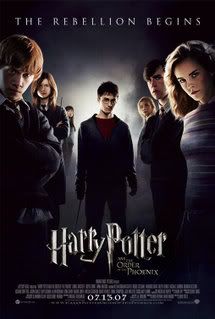
After a summer of movies filled with second, third, and fourth sequels, the most anticipated follow-up is finally here, and it is a fifth installment. Harry Potter and the Order of the Phoenix is the story of Year Five at Hogwarts for lead characters Harry, Hermione, and Ron, although a large portion of the movie occurs outside the grounds of the teens' school. More than a children's book, this episode builds upon strong themes of fear and friendship to create a solid piece of cinema. (Audio review.)

(Note: I have read only the first five books.)

Order of the Phoenix (OOTP) tracks the ongoing saga of the interactions between the dark Lord Voldemort and Harry Potter, who is aided by the titular order, a sort of wizard Joint Chiefs of Staff. Many in the wizarding community doubt Harry's story that Voldemort has returned, and the Ministry of Magic has it in for Dumbledore, all of which means that Harry feels more alone than ever, despite the presence of people and places he loves. As always with a movie adapted from popular literature, two questions must be answered. 1) Was it a good movie, and 2) Was it a good adaptation of the book? Pleasantly, the response to both questions is yes, though each affirmative requires unique qualification.

Having read the book, judging the movie strictly on its own merits is very difficult, because gaps on screen are filled in subconsciously by knowledge of the book. But this movie seems to succeed apart from those pages. Relatively unknown director David Yates keeps the story Harry-centric, giving it a brisk pace and making the main arc easy to follow, although a few other truncated storylines and characters will be enjoyed more by those who know them fully. Expanded motifs of Harry's anger and loneliness are expressed clearly but not heavy-handedly, through both pictures and the words of multiple characters. As was the case with the previous two installments, viewing this movie without first reading the book may result in confusion or at least a lesser understanding of everything, but having seen the first four movies will be plenty to let one comprehend this episode to an enjoyable extent.

The latter question is more complicated. Many people will complain about plot elements that vary from the book. Those objections are true but invalid. Maybe a beloved character was axed, tweaked, or minimized. Perhaps a treasured moment was omitted or included in a disappointingly disparate manner. Make no mistake about it; many things were altered. But when an 870-page tome is being condensed into a two hour and eighteen minute movie, cuts must be made. Much like time constraints demanded that The Lord of the Rings focus largely on Frodo at the expense of favorites like Tom Bombadil, this story must focus on Harry Potter. There are reasons that he is the title character. So no one gets to see Firenze teach or Ron and Hermione fight or anything about Quidditch or prefects. Looking objectively at the modifications though, the primary story arc does advance satisfactorily without those missing parts. Perhaps the galloping pace could have slowed to a canter, as the movie was indeed a rarity that could easily have been twenty minutes longer. But the purpose should then have been to expand upon the elements already in place rather than to add missing ones.

The more important goal is that the movie be faithful to the spirit of the book, and on that level, OOTP hits its mark. Prisoner of Azkaban displayed the world of wizards better than any other Potter movie because of two key inclusions: the little ways magic was used in the background and the fantastic scene-setting shots. Yates nearly recaptures Alfonso Cuaron's brilliance, approaching it with elements like kittens wandering around in pictures and spectacular zooms over Hogwarts. Of equal importance, he also executes small moments even better than the source material, wonderfully depicting simple enjoyments like laughter and friendship are a stark contrast to the lurking complex evil of You Know Who. These small interactions imbue the movie with a soul that adds substance and humanity to an adventurous and magical universe.

OOTP suffers slightly from middle-film-in-a-series syndrome, but in a good way. Much like The Two Towers or The Matrix Reloaded, one gets the feeling that it picks up and ends mid-story, with only a necessary modicum of resolution, as though setting the stage for something grand. That promise of something huge just ahead actually enhances the power of the movie. It leaves one desperately awaiting the next chapter more so than any other Potter movie. Harry Potter and the Half-Blood Prince, the next in the series, screams to be (re-)read before the seventh and final book is released next Saturday.

Ultimately, viewers who have not read the book should be able to follow along easily, and the movie should quench the appetites of fans with reasonable expectations. The gist of the book is explored in numerous ways, resulting in an experience that will leave one with a few thrills and chills, and a smile on one's face.

Bottom Line: A concise return to the spirit of the book, capturing the world with a proper dose of cinematic license. 7 of 10 for the second best movie in the series.


Edit: Oh yeah, like most all of the adult cast, Imelda Staunton rocks as Dolores Umbridge, worthy of hate mere seconds after appearing on screen.

Edit #2: Here's an interesting interview with Michael Goldenberg, the screenwriter who adapted the book.

7.06.2007

Yippee-ki-yay...

If you're worn out by the relentless parade of movie heroes sporting tights or transforming into robots, good news currently awaits you at the theater: Live Free or Die Hard, a physical, action-packed antidote to comic book movies, which is the fourth chapter in the cinematic adventures of Detective John McClane. Having already survived Germans at Nakatomi Plaza, revolutionaries at Dulles Airport, and more Germans in New York City, McClane (Bruce Willis) is once again in the wrong place at the right time, as his simple task morphs into yet another odds-defying assignment. (Audio review here.)

Willis brings back his familiar character with a pitch-perfect blend of world-weariness and cocksure attitude. While he's saving the country, McClane has an innate ability to blend comedy with capability, willingly hurling unsavory nicknames and spewing determined anger rather than blandly yet skillfully executing his mission. Live Free separates itself from traditional action/adventure movies by organically working the humor into the fabric of the movie, rather than lazily relying on comic relief characters or contrived situations. Justin Long, perhaps most recognizable as the Mac guy in Apple's television ads, plays off Willis well as he is sucked into the chaotic events, with a defensive sarcasm and semi-rebellious side that effectively embody his role as a twenty-something computer hacker.

The comedy isn't the selling point of the Live Free though. The trailer promised huge effects, and the movie delivers in a BIG way. Oversized vehicles ranging from semi trucks to fighter jets are involved in adrenaline-pumping confrontations, and of equal importance, they bob and weave in relatively sensible ways. As opposed to the incomprehensible massive chaos of Transformers, there is an elegance to the action here. It's still over-the-top, but in an linear, choreographed manner that is easily followed and relished. Even though many of the stunts undoubtedly use CGI, the old-school physicality provides a sharp and enjoyable contrast to the digital attack the enemy is unleashing on the United States, as well as the cartoon-ish nature of many comic book movies.

Live Free has its share of improbability, as characters survive dangerous falls and endure endless physical abuse, and the technology sometimes seems all too easy. But in a movie like this, such conveniences are accepted if not expected as part of the genre. This isn't a serious Oscar contender with grand themes or undertones; it's summertainment, a popcorn movie designed as a diverting escape. In that regard it succeeds wildly, inducing winces, yells, and cheers from the audience.

One interesting note is that this rendition of Die Hard is rated ''only" PG-13, no doubt in an attempt to lure the lucrative teenage demographic. Some will be outraged by this apparent neutering of a franchise that was largely defined through the the R-rating earned by the pervasive vulgarities of the first three installments. Even the signature line (Yippee-ki-yay...) is obscured by sound effects. On one hand it's disappointing that Hollywood acquiesced to the almighty dollar. On the other hand the absence of a constant barrage of language is scarcely missed, as McClane's aggressive attitude is still intact, accompanied by plenty of derogatory terms that are not quite as profane. Maybe he mellowed with age.


Bottom Line: The best action movie so far this year. A rock solid 7 of 10.

7.02.2007

Less than meets the eye.

I have low expectations for summer movies. I realize that they are often mindless entertainment with minimal plot and multiple explosions. That's fine. There is a place for such flicks, and I watch them without much hope of something grand. Remember that as I say this with no exaggeration: Transformers is the worst summer blockbuster I have ever seen. Let me take you through the anatomy of this horrible movie. (Audio review here.)

From the stiff opening voiceover that details the backstory, you sense trouble. Thirty minutes in, you're still waiting for the movie to gain traction, even though a big action sequence already happened. As the action wanes, the awkward dialogue blares through. You realize this isn't Shakespeare, but George Lucas could have improved this script. Simple words in the midst of action are one thing, but as the focus of several too-long scenes, the lame dialogue is painfully amplified. When you're not sure if the humans are delivering their lines better than the robots, that's a bad sign.

But you know more transformers are coming, so you wiggle your feet impatiently while anxiously awaiting their arrival. Finally the rest of the good guys show up. "Wow, those are sweet looking robots!" you think. You begin to settle in for a rip-roaring second half, until you realize there's not much else to them. It's like finally getting a date with that hot girl you've been crushing on, then realizing how unbelievably vapid she is before the main course is even served.

By then of course you're stuck for the remainder of the evening. You deal with the ill-fated attempts at creating drama. Every ten minutes, you wonder what the heck is happening or question the movie's logic, which is awful even for the genre. You laugh several times, though the causes are largely unintentional. Is that John Tuturro wildly out of place? Does Tad Hamilton actually have a leadership position in the military? You hope desperately that the show might end with something redeeming like an epic battle. Here come all the bad guys (out of nowhere), this could be good...but no. The final clash is big and loud, but also confusing and by that juncture, pointless. Emotional attachment isn't necessary in a popcorn movie, but there needs to be at least a minute level of curiosity. You don't care if they kill the humans or kill the robots or kill all of them. Whatever.

You sit through the credits, unsure of whether or not you want to be rewarded with a bonus scene. Yep, there's one. Yoikes, that was bad. At least it was short. Wait, there's one more, a final reminder of how miserably the movie failed, like the last rock that always crushed Wile E. Coyote.

The worst part is that Transformers has potential, as the trailer proves. Vehicles turn into giant robots! How is that not cool?!? But the flick scarcely if ever delivers on that promise. The visuals are representative of the whole movie. Well done, occasionally impressive, but too often fights or transformations are seen either from a distance too great or too close, depriving the audience of the true scope of the shot, and of any interest in the movie.

Perhaps a knowledge of the source material, with which I am only passingly familiar, would make the movie more palatable, but I doubt it. Director Michael Bay, whose projects have steadily declined since 1996's The Rock, has reached a new low.

Bottom Line: Please don't encourage a sequel by seeing this movie. 2 of 10.

6.21.2007

Fantastic Four

Five movies into the summer of the sequel, the first release that is not a third installment is finally here. The Fantastic Four: Rise of the Silver Surfer is merely the second in a series, following 2005’s original that introduced moviegoers to Mr. Fantastic (Ioan Gruffold), The Invisible Woman (Jessica Alba), her brother The Human Torch (Chris Evans), and The Thing (Michael Chiklis). (Audio review here.)

The story in this follow-up is basic superhero stuff, picking up not too long after the last one ended. Mr. Fantastic is getting ready to wed The Invisible Woman, then bad things happen, and The Fantastic Four are called upon to remedy the problem, which involves the Silver Surfer destroying the planet and Dr. Von Doom doing whatever it is he does.

From there the heroes do their hero thing, which is accompanied by just enough side story to form slightly rounded characters and plot. Like its predecessor and the comic books on which they both are based, Silver Surfer is a different breed of superhero movie, one that varies in tone and content from recent renditions of more popular heroes like Batman, Superman, and Spider-man. With its multiple lead characters, Silver Surfer occasionally reminds of the X-Men flicks, but does not match the gravity present in those movies or other recent hits featuring the aforementioned main characters. Those are serious, more intense movies that can create wonderful cinematic experiences that feel more “real”. Not that any of these kinds of movies are truly real, but both of the Fantastic Four movies have a more cartoon-ish feel that distances them from reality.

This is both a blessing and a curse. On the downside, Silver Surfer does not have the emotional attachment that other superhero pictures have or at least desire, which limits the scope of the movie’s power. A surprising side effect is the everyday levity that is provided. If you and your buddies had bizarre superpowers, wouldn’t you frequently be making fun of each other’s gifts and using your own for not entirely kosher reasons? Movies with solo protagonists are rarely able to capture such interactions, but with its tight-knit lead characters, Surfer can and does, with degrees of success that vary like most attempts at humor, from clever and hilarious to flat and unfunny. Nothing is brilliant or profound, everything just creates a casual surface relationship between movie and viewer.

The minimal depth also allows for a streamlined hour and a half movie that has cursory side stories, unexplainable technology, and vague villainous motives, all of which is completely fine, if not preferable. Just as popcorn should not be loaded with substantive fruits and vegetables, popcorn movies like this one should not be loaded down with messages and complications that don’t enhance the story.

The shallow story and characters possessing only one or two dimensions means that the movie never has much chance of succeeding on multiple levels, so if you expect a serious action movie, you will be disappointed with Rise of Silver Surfer, as you likely were with the original. If you expect mindless superhero entertainment and a near carbon copy of the first installment, then you will leave the theater content with what you saw.

Bottom Line: There is a place for movies like this: DVD rental. 5 of 10.

6.14.2007

Analog players in a digital world.

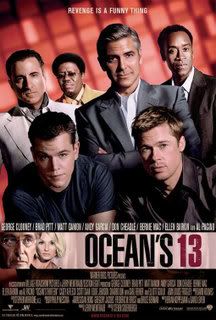
The latest movie in this summer of the sequel is a departure from the first three heavyweights of Spider-man 3, Shrek the Third, and Pirates 3. Aimed more at adults than adolescents, Ocean’s Thirteen is the clean-up hitter this summer. In baseball, a clean-up hitter usually has power. Ocean’s Thirteen has star power, perhaps more than any other release this summer, and the movie wields its weapons well. (Audio review here.)

While Julia Roberts and Catherine Zeta-Jones are not back for this installment, all the men of Ocean’s Eleven and Ocean’s Twelve do reprise their roles. George Clooney and Brad Pitt head up the gang of thieves, aided by Matt Damon, Don Cheadle, and the rest of the crew that moviegoers have come to know over the last six years. The biggest addition to the cast is a name bigger than all of them, and his character is the catalyst for the caper that drives the entire film. The man is Al Pacino, playing a flashy casino owner who incurs the gang’s wrath by betraying Elliott Gould’s Reuben Tishkoff, setting the stage for the rest of the revenge movie.

The first film was a modern classic that thrived on the energy of Las Vegas and the cool confidence of Clooney and Pitt. Twelve lost much of those factors by bouncing around Europe and putting the band of thieves on the run. Thirteen returns to the franchise’s successful roots, taking place predominantly in the colorful world of Sin City and also placing the heroes in control most of the time.

In restoring those two key elements, Ocean’s Thirteen recaptures the spirit of the original. The dialogue isn’t as crisp or smart, but it’s close, and elements of the past glory are present. Things like con-man lingo and everyone bilingually communicating with The Amazing Yen provide well-done unexplained humor. Writers Brian Koppelman and David Levien (who penned quality guy flicks like Rounders and Knockaround Guys) do overuse the borrowed elements, as though they decided to repeat the good parts of the original’s script as often as possible, and the resulting jokes wear a bit thin over the course of the movie.

Returning to Vegas is a wise choice that simplifies the plot. Though staples of heist movies, like double-crosses and sleight of hand, are present, the story is largely straight forward. You know what the guys are going to do; you’re just watching to see how the crew overcomes the various inevitable obstacles. This makes it slightly less entertaining, but also makes for a very comfortable viewing experience, despite the required suspension of disbelief. The cinematography of Steven Soderbergh (under the pseudonym Peter Andrews) helps too; the pictures and transitions are not to the impressive level of Eleven, but they have their moments, as do the quirky uses of titles and graphics.

As is the case in many sequels, the cast slides effortlessly back into their roles. Clooney and Pitt are smooth; Damon is trying to prove himself; Bernie Mac is a fast-talker, etc. As the new guy, Pacino effectively joins the fray with a surprisingly underplayed part. He’s not the big, bold, brash near-caricature that he has morphed into through movies like Scent of a Woman and The Devil’s Advocate. He still looks the over-the-top part with his deep tan and vibrant suits, but he is more kniving than bombastic, which is a very appropriate choice for the movie.

Ocean’s Thirteen is the cinematic version of a lazy river ride at a water park. You hop in your inner tube and cruise around the lengthy pool, admiring the view, chatting with friends, and generally enjoying the laid-back experience. Unlike many of this summer’s blockbusters, it does not bombard you with loud effects or action scenes. It won’t shock and awe you by pulling wool over your eyes with a mind-blowing twist. Instead, gentle turns and reveals are sprinkled throughout, providing an enjoyable two hours spent with familiar and entertaining characters.

Bottom Line: A good summer diversion that returns to the roots of the series. Not as good as the first, but better than the second. 7 of 10.