1.25.2008

Cloverfield.

Cloverfield is the brainchild of producer J.J. Abrams, the man behind other cult-ish media like television's Lost and Alias. The exceptional first trailer established the simple premise. Something attacks New York City; chaos ensues. That preview combined with a well-executed buzz-inducing marketing strategy to create the rare eagerly anticipated January release.

What is Cloverfield? Much of the movie’s entertainment is derived from its mystery, so all you get is: something attacks New York city; chaos ensues. If you're worried about this being an I Am Legend retread, forget about that. In a way this is the opposite of I Am Legend. Much of that movie was a slow build, not so much about the action as the psychological side of isolation and determination; this is different. The first half hour is far too long and uninteresting as it introduces the main characters, a group of twenty-something yuppies at a going-away party in New York City. You could show up thirty minutes late and not miss a thing. Then a seismic event occurs, triggering mild panic that soon morphs into complete bedlam, and the fast-paced remainder of the movie unfolds in quasi-real time.

All of this so far may sound (and is) mildly interesting, but the selling point of Cloverfield is this: the movie is shot in the first person, as though from a personal camcorder. There are no wide shots, no big pictures to set the scene, and nothing to relate the scope of what might be happening. The camera is always held by one of the characters, unless it is momentarily dropped or set down. The movie even features cut-in portions of what was previously on the tape before the fateful day's events were recorded. The shaky picture often makes Bourne Supremacy look stable and provides only a partial view of the various occurrences, a clever technique that is both intriguing and annoying in its unconventionality. Though the idea is not completely novel (see: The Blair Witch Project), such an approach is unique enough to entertain on its own merit. It’s actually the best part of the movie, even though the lack of full information is often frustrating. Since the camera tracks the same people throughout the movie, the humanity should be a main hook. However none of the main characters are remotely interesting or sympathetic. Thus the human drama is disappointingly minimal, and the narrative power of the movie is almost non-existent, nowhere near the brilliant concept’s potential.

With its handheld camera and viral internet marketing strategy, Cloverfield is undoubtedly trying to capitalize on and connect with the YouTube generation. The approach fails in part because handheld shots work far better in a secondary or tertiary role. As the primary method of informing, such a process can be as bothersome as it is creative. With that aspect inconsistently entertaining and the catastrophe never entirely explained, the movie's momentum occasionally falters, forcing one to more deeply ponder what the heck is happening.

The anticipatory bar is set high enough that Cloverfield has very little chance of living up to the hype. But the problem is not the massive buildup, but that the movie itself is simply not very interesting beyond its excellent cinematographical gimmick and the big question of WHAT IS IT? Perhaps those who have absorbed themselves in the web chatter surrounding the movie will think otherwise.

Bottom Line: Cloverfield gets a borderline recommendation for the filmmaking experiment, but the story sinks otherwise. 5 of 10.


P.S. Rumors are that a sequel may be in store, with the intent of showing the entire debacle from a different person’s video camera, which would be another interesting experiment.

1.18.2008

Juno.

Independent films are an interesting breed. Made outside the mainstream studio structure, the best ones compensate for their lower production value with a better story and characters. Every year an indie or two does captures the collective fascination of critics and the public by doing so. This year's darling is Juno, the name of the newly pregnant teenage girl around whom the simple story revolves. (Audio review here.)

Like many such films, Juno's strengths lie in its unique characters. Foremost among them is the titular one, who has a singular vernacular and attitude that carries the movie. As she decides what to do with the child, she must also deal with the various reactions from her family and friends. But rather than become depressed or reclusive, Juno instead chooses a positive approach, dealing with her issues directly and responsibly. This leads to a relatively sunny take on subjects often approached in a dark or politically charged manner. The movie does tell you what to think about issues; it does not argue strongly either way; it just tells you what characters are doing, and gives a little of their rationale, somewhat like Clint Eastwood's phenomenal Million Dollar Baby a few years back.

On one hand, making light of serious situations like abortion and divorce feels wrong. Conversely, the ability and opportunity to laugh at potentially overbearing situations is a relief, and it is part of what makes us human. While such reactions likely would not be appropriate in reality, movies are not reality, but an escape in which a little levity is more than appropriate.

From the guitar-laced harmonic strains of its soundtrack to the aforementioned quirky characters, Juno is a quintessential indie flick. Like Garden State, it has a few transcendent glimpses into the human soul, but they are too few and far between to carry the movie to extreme heights. Like Little Miss Sunshine, it places quirky characters into unusual and often comic circumstances, but the humorous moments here do not approach the hilarity of Little Miss Sunshine. Most of the comedy is based upon the unique dialogue or the continual series of culture clashes between Juno and everyone, which are amusing throughout.

Some critics (Roger Ebert) are hailing Juno as the year's best film, which is a drastic overstatement. Such grand labels are a joke, and a statement on how monotonous comedies have become. Its ipseity amidst the dramatic leanings of most Oscar contenders makes the movie better and more enjoyable than it actually should be. Juno is a cool breeze drifting through an open window, not an eye-popping blast from the air conditioner. It is enjoyable and well-crafted, not the best film of the year, maybe a fringe contender for the top ten.

Bottom Line: The movie is equivalent to its main character: cute and likeable, but lacking in a few areas. Recommended primarily for indie fans. 7 of 10.


Side Note: As I mentioned in an earlier comment, after this year's Oscars, I'm blowing up my rating system and starting anew. I'm tired of giving everything a seven.

12.28.2007

No Country for Old Men.

No Country for Old Men is a not an overhyped blockbuster movie. If you have seen the trailer, you probably thought it looked rather strange. You would be right, but in a wonderful way. (Audio review here.)

The movie is difficult to pigeonhole, but the story, set in 1980 in rural Texas, is fairly straightforward. Josh Brolin plays Llewelyn Moss, a rugged native who stumbles across a deserted murder scene where he discovers and absconds with a case full of money. From that point on, two men head up two very different methods of pursuit. Tommy Lee Jones is small town sheriff Ed Tom Bell (phenomenal name), who is trying to figure out what happened. Javier Bardem, whom you might recognize from The Sea Inside or a small role in Collateral, is a ferociously single-minded individual who has been hired by less than scrupulous people to track down the missing cash.

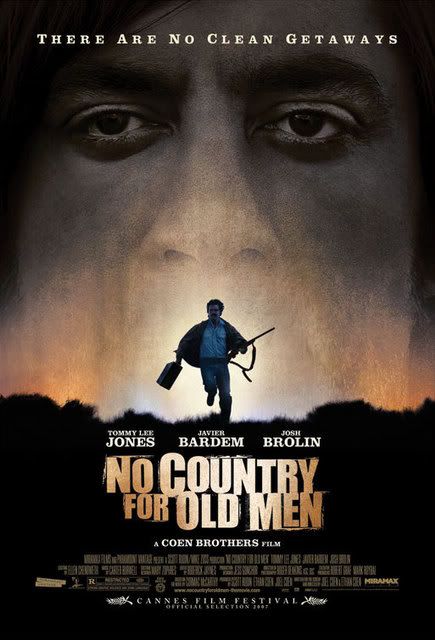
The movie is directed by the Coen Brothers, who have put together high quality offbeat films like O Brother Where Art Thou, Fargo, and Blood Simple. In those movies and many of their others, the brothers combine familiar movie elements into a single amalgam that defies being defined as a single genre. With No Country for Old Men, they have done the same thing, creating a movie that might be best described as a neo-western. Its deliberate pace, scenic framing, and South Texas location call to mind classic westerns. The tagline for the movie is that "There are no clean getaways," which implies that this is a heist movie. There are parts of that genre, and there are major components of a chase picture, all tweaked to fit the technologically crude era of 1980.

Now, that's the setup, but is this offbeat movie any good? The critics sure think so. Plenty of critics societies have already named this the best picture of 2007, including groups from from New York, Chicago, Boston, Dallas, D.C., and the National Board of Review. It's also probably the current favorite to win the Best Picture Oscar, for praiseworthy reasons that are easy to spot and completely justified.

The three lead performances have grabbed the headlines, and understandably so. Javier Bardem is absolutely terrifying in his atypical villainous role. There is no gimmicky mask or superpower, just pure evil. With merely a look or a stride, he exudes menace, more force of nature than mere bad guy. He is a bad dude, both fantastic and frightening. Because Bardem is so good, he overshadows Josh Brolin, who disappears into his self-confident Texas denizen, playing the chasee with a confidence that makes him an excellent anti-hero. Tommy Lee Jones is stellar as usual. He embodies a world-weary sheriff with one of the best combinations of drawl and lingo that you will ever hear. His drawl is accompanied by a script that is taken in large part directly from the book on which the film is based. The words are rife with a vernacular that could not be more perfect, eliciting grins from the viewer with both their humor and suitability. Even when you don't know what is said, you know precisely what it means. Of these three turns, Bardem has won many awards already, and will almost certainly be nominated for and win an Academy Award. Even though Brolin and Jones have not yet received many accolades, both are worthy of such honors; the problem being that that they are frequently eclipsed by Bardem's chilling portrayal.

Due to the magnetic acting of the leads and the character actors, who are great as they look and sound as though they have spent their entire lives baking in the dry heat near the Mexican border, the movie is extremely compelling despite a deliberate pace and almost no background music during its two-hour running length. Most chase-type movies are fast-paced and action-packed, leaving little time for suspense to grow; this is the opposite. There are no quick-cutting action scenes, but instead heart-pounding scenes that slowly ramp up the tension. Those intense parts are complemented by quieter scenes of conversation or investigation that maintain a foreboding dramatic undertone of upcoming conflict. While the film loses some of its building momentum late in the story, and the denouement does not quite match the brilliance of the preceding hundred minutes, the closing moments remain appropriate for a movie that doesn't offer any easy questions or answers.

All in all, this is a movie that is definitely worthy of the countless honors that it is receiving from critics across the country. Assuming the writer's strike doesn't waylay the Oscars, I suspect that this will be the frontrunner for Best Picture, and I'd bet a good chunk of money that Bardem will snag a Best Supporting Actor trophy. His performance and the film on the whole stand out from the year's crowd and are worth seeing, not for the popcorn movie crowd, but for fans of good, well-crafted cinema and story-telling.

Bottom Line: One of the best of the year. 8 of 10.

Disclaimer: This movie is rated R, for pervasive blood and brutal violence, and to a lesser extent, language. DO NOT take kids to this movie. Some adults won't want to see it either.

12.21.2007

You are not alone.

I Am Legend debuted last weekend with a monstrous $77 million weekend, but is an atypical Will Smith blockbuster, largely bereft of the slam-bang action and/or comedy common to his big movies like Men in Black or Enemy of the State. (Audio review here.)

As learned from the tagline and excellent first trailer, the premise is simple: Smith is Dr. Robert Neville, the last man left in a desolate New York City, but he is not alone. Someone or something lingers, a mystery that drives the first hour, which is absolutely fantastic. With the exception of a few flashbacks that gradually answer the hows and whys generated by the plot progression, Smith interacts with no one except Sam, his loyal German Shepherd.

In this regard, I Am Legend is a cousin to the amazing Cast Away. While their respective tones are drastically different, both are set on islands void of humanity. Instead of a volleyball, Smith anthropormorphizes a dog. Hanks wrestled with inner demons on his deserted island, Smith confronts outer demons of some sort. The difference in supplies is noteworthy, and the two main characters are driven by widely disparate motivations, but the isolated survival instinct is similar, and watching Smith stretch himself as an actor is extremely enjoyable. Smith's character still possesses elements of the cocky, wise-cracking nature that moviegoers know well, but with merely a glance or a twitch, his confident veneer often cracks to reveal the effects of his time spent alone. Seeing that uncharacteristic vulnerability is initially disorienting, because we're not used to seeing a hero crack like this, but the awkwardness soon yields to awe at the powerhouse solo performance.

Aside from Smith's turn, the highlights of the movie are the breathtaking shots of a desolate New York City. We've seen the empty streets of a booming metropolis before, in movies like Vanilla Sky and 28 Days Later, but this is different. Not only is everything deserted, but also overgrown and eroded by nature and time. The minimal music and slow-moving cameras allow for an eerie and appropriate quiet within the movie, creating a game of I Spy in which one's eyes dart about, searching for familiar landmarks like Jumbotrons or Broadway signs.

The only downside to all this quality is that it doesn't last throughout the entire movie. Without giving too much away, I can say that following a key plot development, the third and final act transforms into a more familiar, action-type of movie, leading to a finale that satisfies, but doesn't quite match the preceding hour-plus. This dissonance is very reminiscent of 2004's Collateral, which similarly enthralled throughout before wimping out at the end, like a color scheme that matches at first glance but clashes upon closer inspection.

If you know what you are in for, you will enjoy the movie more thoroughly. I Am Legend is much more Cast Away than Independence Day, more Signs than Bad Boys. In his best performance yet, Will Smith proves that he has the acting chops to match his pretty face and ripped physique, deepening his own cinematic legend as he frequently carries this movie to great heights.

Bottom Line: Two-thirds of a great movie plus one-third of an average movie equals a good movie. 7 of 10.

12.15.2007

Bee Movie and Batman.

As is evident from the trailer, Bee Movie is essentially what might happen if the public persona of Jerry Seinfeld were placed into the three-part body of a bee. Main character Barry B. Benson is Seinfeld, complete with wry comments, high-pitched excitement, and a slight disdain for authority. Unsurprisingly, the plot is a tad strained, but does provide a framework stable enough to sustain the various inevitable punchlines. The movie tastes sweetest when using Seinfeld's jabbing humor to poke fun at either the industrious efficiency of the hive or the oddities of humans. In this regard, Seinfeld shines as usual, leaving the engaged viewer smiling consistently, chuckling frequently, and roaring occasionally.

Determining whether or not you will like Bee Movie is a simple process. If you like Seinfeld's blend of comedy, you'll enjoy it. If you don't care for his observational humor, steer clear. It's really that simple.

Bottom Line: 6 of 10, plus one because I like Seinfeld.

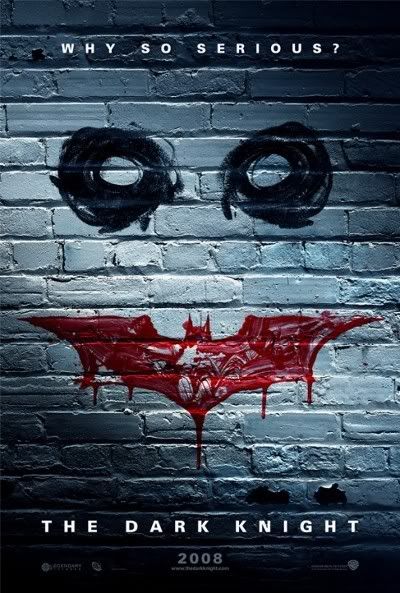
Since the review was truncated, here are two fantastic new Dark Knight movie posters

I particularly love these two as a pair, with the contrast of menace and protection, frozen in what could conceivably be the same moment. Next year, this movie, Indiana Jones 4 (more on that soon), and Prince Caspian are all scheduled within a month. WOW!

12.10.2007

Do you have any hope at all in humanity?

I haven't read any of Stephen King's books or stories, but I have learned two things from his movies. He possesses phenomenal insight into the human mind, and he is a freak. The Mist proves both points fully with a simple story: a mist engulfs a small New England town, and a few dozen of its denizens are isolated in a grocery store, forced to deal with enemies both outside and inside the store, both strange and familiar.

The best and brilliant parts of The Mist are the explorations into the psyche of the various trapped townsfolk. If someone's character is truly exposed when under pressure, then the extreme circumstances of this movie strip souls down to their essences, with frightening results. There are heroes and villains, leaders and followers, stalwarts and cowards. In previous uses of King's source material, writer/director Frank Darabont burrowed into the heart of hope in The Shawshank Redemption and delved into faith and the supernatural with The Green Mile. Both movies placed normal people into extreme circumstances, and did so exceptionally well. In that general thematic regard, Mist is similar to those two excellent films. More specifically though, it varies greatly, stressing the negative aspects of humanity rather than positive traits. Along the way, plenty of complex issues arise, and they are most frequently addressed with a rough, dull blade that gashes boldly through the moral fiber of civilization. The results are rarely pretty, but always compelling.

Lest you think this is a philosophical art house movie, let it be known that as a horror flick, independent of any deeper meaning, Mist consistently entertains, with a handful of superb knuckle-whitening scenes enhanced by an excellent cast. But a dark decision in the final act makes it impossible for even the most casual moviegoer to completely ignore the thick subtext of King and Darabont.

What prevents The Mist from being a great movie is the frayed nature of that subtext. While the story is rife with interesting points, the commentary fails to coagulate into a comprehensible bigger picture. In a sense though, the fractured themes better befit such a moody picture, one that strikes its audience at many levels, leaving the mind spinning in a mist of its own.

Bottom Line: 7 of 10 for a movie far smarter and deeper than the glut of recent horror releases.

12.05.2007

A darker movie and a Dark Knight.

1) Prince Caspian trailer. May 16th, 2008. I'm stoked.

2) The Dark Knight. July 18th, 2008. I'm stoked.